
A new international study led by researchers from the ARC Training Centre for Bioplastics and Biocomposites has found that concern about plastics is widespread across the globe, with strong public support for action to address their environmental impacts.
Published in Cell Reports Sustainability, the research surveyed more than 4,000 people across Australia, the Netherlands, India and the Philippines, using large, nationally representative samples in each country. Despite major differences in culture, waste management systems and policy contexts, the results show a striking level of consistency in how the public views plastics.
Plastics consistently ranked as a top environmental concern
Led by Dr Leela Dilkes-Hoffman, with co-authors Bronwyn Laycock, Steven Pratt, Helen Ross and Paul Lant, the study found that plastics are rated as one of the most serious environmental issues across all four countries. High levels of concern were observed across age groups, genders and education levels, indicating broad public consensus.
Participants also expressed strong support for solutions to address plastic pollution. Recycling and the use of biodegradable plastics were viewed particularly positively, while more transformative changes, such as products being sold without any packaging, received lower levels of support. The findings highlight where further engagement, design innovation and policy leadership may be needed to enable system-wide change.
Public interest is ready for action
Reflecting on the results, the authors note that
“Public interest is in place and ready. There should be no delay in pursuing solutions.”
The study also concludes that concern for the impacts of plastics is present worldwide, implying public backing for global-level actions such as a global plastics treaty.
This widespread concern, combined with consistent support for practical solutions, suggests that social licence already exists for stronger industry action and policy intervention.
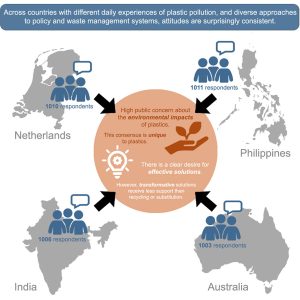
Graphical summary of key findings from the international survey, showing widespread concern about plastics and support for solutions across countries.
Building on long-term research into public attitudes
The new study builds directly on a long-standing body of research led by Dr Dilkes-Hoffman examining public attitudes toward plastics in Australia. Previous work from the Centre has shown that public concern about plastics has remained surprisingly stable over time, even as awareness, media attention and policy discussions have increased.
Related research has also explored how biodegradable packaging influences littering attitudes, providing important insights into how material choices and product design can shape behaviour in real-world settings.
Together, this growing evidence base demonstrates the importance of understanding public values and expectations when developing sustainable materials, packaging systems and waste management strategies.
Read more
📄 Dilkes-Hoffman, L., Laycock, B., Pratt, S., Ross, H., Lant, P. (2026).
An investigation of attitudes toward plastics in four countries — The public is concerned and wants solutions.
Cell Reports Sustainability https://doi.org/10.1016/j.crsus.2026.100683
Related Centre research:
- Public attitudes towards plastics in Australia remain constant
https://doi.org/10.1016/j.resconrec.2025.108329 - Do biodegradable plastics increase public acceptance of littering?
https://doi.org/10.1088/2515-7620/ad9817

