
Polyurethane (PU) is one of the most versatile classes of plastics used today. Polyurethane foams are found in everyday products such as furniture, mattresses, insulation, packaging, automotive interiors, coatings, sealants and adhesives. By adjusting their formulation, polyurethanes can be made flexible or rigid, soft or load‑bearing, making them essential across many sectors.
This same versatility, however, creates challenges at end of life.
The polyurethane waste challenge
Most polyurethane foams are durable, crosslinked materials that do not fit easily into conventional recycling systems. As a result, much of the polyurethane used today is managed through disposal pathways such as landfill or incineration, rather than being recovered and reused.
Existing recycling approaches have struggled to fully address this challenge. Many methods focus on partial material recovery or produce products with reduced value, making it difficult to move toward truly circular systems where polyurethane components can be returned to manufacture.
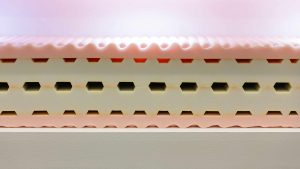
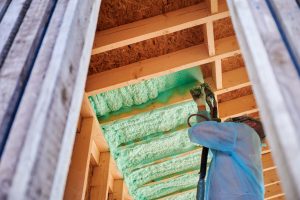
Polyurethane products in everyday applications
Bio‑based polyurethanes and the role of lignin
To reduce reliance on fossil carbon, there has been growing interest in bio‑based polyurethanes, particularly those incorporating lignin as a partial replacement for petroleum‑derived polyols.
Lignin is an abundant biopolymer derived from plant biomass and industrial residues such as sugarcane bagasse. Its aromatic and chemically rich structure contains multiple reactive groups that are compatible with polyurethane chemistry. This allows lignin‑derived polyols to participate in polymer formation rather than acting as inert fillers.
In practice, lignin is typically blended with conventional polyols to balance performance and processability. While this increases renewable content and reduces fossil inputs, it does not fundamentally alter the polymer structure of polyurethane.
Importantly, bio‑based does not mean biodegradable. Once lignin is chemically incorporated into the polyurethane network, the resulting foam remains a durable, non‑biodegradable material.
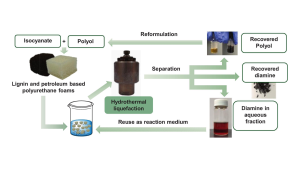
Schematic overview of polyurethane foam recycling via hydrothermal liquefaction, showing simultaneous recovery of polyols and diamines from petroleum‑ and lignin‑based foams, aqueous phase reuse, and reformulation into new materials.
A recycling breakthrough for durable plastics
A recent open‑access study from researchers at Queensland University of Technology (QUT), published in Chemical Engineering Journal, demonstrates a chemical recycling pathway designed specifically for durable polyurethane foams, including lignin‑based formulations.
The study uses hydrothermal liquefaction, a water‑based chemical recycling process, to break polyurethane foams down into their original chemical building blocks. Crucially, the process enables the selective recovery of both major components of polyurethane:
- Polyols, which represent significant embedded value
- Diamines, formed from the hydrolysis of isocyanates, which must be carefully managed but can be reused as chemical feedstocks
The recovered polyols were reused to manufacture new polyurethane foams, producing materials with physical and chemical properties comparable to those made from virgin components. The study also demonstrated that the aqueous phase of the process could be reused, reducing waste and improving overall process sustainability.
Together, these results show a credible pathway toward closed‑loop recycling of polyurethane foams, rather than downcycling or disposal.
Why recycling, not biodegradation?
At the Centre for Bioplastics and Biocomposites, significant research effort is dedicated to polymers such as polyhydroxyalkanoates (PHA) that are intentionally designed to biodegrade in appropriate environments. These materials are well suited to applications where short service life and environmental exposure are expected.
Polyurethane addresses a different need.
For high‑performance, long‑life applications such as insulation and structural foams, durability is essential. In these cases, biodegradation is neither realistic nor desirable. Instead, sustainability depends on whether materials can be recovered, reused and kept in circulation.
This research shows that even when polyurethane incorporates renewable feedstocks such as lignin, recycling remains the most responsible end‑of‑life pathway.
Not all sustainable materials should biodegrade. For durable plastics like polyurethane, circularity means designing systems where value can be recovered, reused and kept in circulation.
Looking ahead
This work advances the development of circular strategies for complex polymer systems and highlights the importance of aligning material design with end‑of‑life solutions. Future progress will depend on:
- Scaling chemical recycling technologies
- Improving collection and separation of polyurethane waste
- Designing materials with both performance and recyclability in mind
Together, these steps offer a pathway toward reducing landfill, lowering environmental risk, and retaining the value embedded in durable polymer materials.
Read more
📄 Widanagamage, G. W., Zhang, Z., O’Hara, I. M., & Moghaddam, L. (2025). Recycling biobased polyurethane foams: Efficient dual recovery of polyols and diamines via hydrothermal liquefaction. Chemical Engineering Journal, 168533. https://doi.org/10.1016/j.cej.2025.168533

