
Polyhydroxyalkanoates (PHAs) are a family of biodegradable and bio-based plastics with significant potential as sustainable alternatives to conventional polymers. One of the most widely studied PHAs is poly(3-hydroxybutyrate) (PHB). However, its relatively brittle nature and limited capacity to interact with water can restrict its suitability for some applications.
In this study, researchers investigated a gamma irradiation-based approach to grafting N-hydroxyethyl acrylamide (HEAA) onto PHB.
The resulting material demonstrated substantially improved performance, including greater flexibility, a 378% increase in toughness, and the ability to absorb more than six times its own weight in water. These changes produced a material with hydrogel-like behaviour while maintaining the strength provided by the PHB backbone.
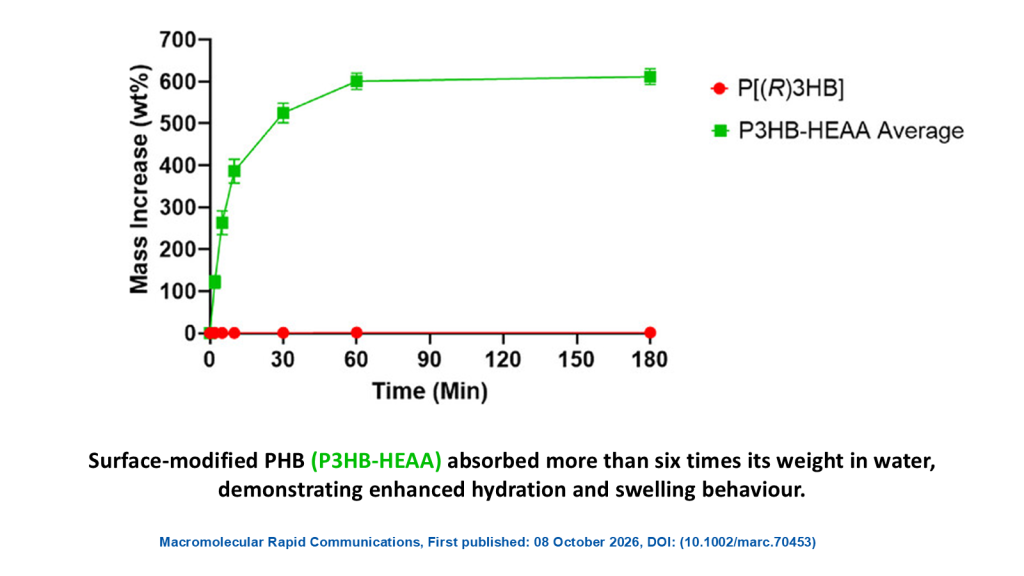
Image: Surface-modified PHB (P3HB-HEAA) absorbed more than six times its weight in water, demonstrating enhanced hydration and swelling behaviour.
Why this research matters
Sustainable polymers must not only be biodegradable, but also provide the functionality required for real-world applications. Research that expands the toolkit available for modifying PHA materials helps address this challenge.
By demonstrating a new approach to tailoring both the hydration and mechanical properties of PHB, this work expands the potential applications of biodegradable polymers and contributes to the development of bioplastics with specialised functionality.
Publication
📄 Walchle, C., Chaléat, C., Lant, P., Laycock, B., Pratt, S., & Lawless, S. (2026). Gamma Irradiation-Based Free Radical Grafting of N-Hydroxyethyl Acrylamide onto Poly[(R)-3-hydroxybutyrate]. Macromolecular Rapid Communications, e70453. https://doi.org/10.1002/marc.70453

