
Polyhydroxyalkanoates (PHAs) are a family of biodegradable and bio-based plastics with significant potential as sustainable alternatives to conventional polymers. However, the relatively low toughness of many PHA materials can limit their suitability for applications that require greater flexibility and resistance to mechanical stress.
In this study, researchers investigated the synthesis of PHA-PHA block copolymers as a strategy for tailoring material properties. Block copolymers consist of chemically linked polymer segments that can combine the beneficial characteristics of different materials within a single molecular structure.
The resulting materials showed improved mechanical performance compared with conventional PHA formulations, demonstrating the potential of block-copolymer design as a tool for modifying the properties of biodegradable plastics.
Why this research matters
Many sustainable materials face a fundamental challenge: they must deliver the environmental benefits of biodegradability while still meeting the performance expectations of manufacturers and end users. Research that expands the toolbox available to polymer scientists helps address this challenge.
By demonstrating a new approach to modifying mechanical properties within PHA materials, this work contributes to the development of biodegradable plastics capable of meeting the requirements of a broader range of applications.
Publication
📄 Kockler, K. B., Lant, P., Pratt, S., & Laycock, B. (2026). Improving the Mechanical Properties of Biodegradable Polyhydroxyalkanoates via PHA–PHA Block‐Copolymer Synthesis. Chemistry – A European Journal, e71303. https://doi.org/10.1002/chem.71303
Graphical Abstract
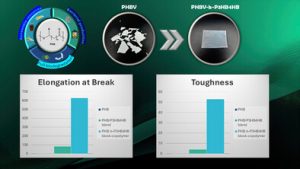
Covalent linkage of a highly crystalline PHBV with a ductile P3HB4HB is shown to produce block copolymers with markedly enhanced extensibility and toughness, outperforming equivalent blends. The results demonstrate that polymer architecture, not composition alone, governs mechanical response, offering a route to biodegradable materials that combine flexibility with toughness.
Abstract
Polyhydroxyalkanoates (PHAs) are materials of high interest due to being bacterially synthesized and biodegradable in a variety of environments. Yet the most commonly available PHAs still lack the mechanical properties needed to truly replace a wide range of nondegradable plastics. Poly(3-hydroxybutyrate) (P3HB) and its copolymer poly(3-hydroxybutyrate-co-3-hydroxyvalerate) (PHBV) exhibit high tensile strength and modulus. However, their high crystallinity leads to a lack of toughness and especially elongation, resulting in a relatively stiff and brittle material. By contrast, the copolymerization product of 3-hydroxybutyrate (3HB) and 4-hydroxybutyrate (4HB)—poly(3-hydroxybutyrate-co-4-hydroxybutyrate) (P3HB4HB)—shows a considerable improvement in elongation at break at higher 4HB contents, but lacks tensile strength and toughness, leading to a ductile but weak material. By coupling these very different PHAs together as a block copolymer, we have produced novel materials with significantly improved toughness compared to the homopolymers as well as comparable blends thereof, with an elongation at break of 630% and a toughness of 52 MJ/m3, more than tripling previously reported results for PHA–PHA block-copolymers. Such attractive properties, comparable to those of commercial nondegradable thin film plastics, point to the potential for use of these biodegradable block copolymers in film applications.

