
Polyhydroxyalkanoates (PHAs) are a family of biobased and biodegradable polymers that are attracting increasing interest as alternatives to conventional plastics. Produced from renewable resources and biodegradable in appropriate environments, PHAs offer significant potential for reducing the environmental impacts associated with fossil-based plastics.
However, one challenge has limited the wider use of many PHA materials: they can be brittle.
One of the most widely studied PHAs, poly(3-hydroxybutyrate-co-3-hydroxyvalerate) (PHBV), possesses excellent sustainability credentials but often lacks the flexibility and toughness required for demanding applications.
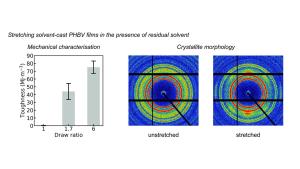
Graphical abstract
Addressing brittleness without changing the polymer chemistry
Researchers from The University of Queensland’s School of Chemical Engineering have developed a new processing approach that significantly improves the toughness of PHBV films without chemically modifying the material.
The study, led by PhD candidate Alia Gallet–Pandellé, investigated a solvent-assisted stretching method in which PHBV films are stretched while a small amount of residual solvent remains within the material.
This relatively simple approach produced substantial improvements in mechanical performance. While unstretched PHBV films typically fractured after stretching by around 2%, the treated films consistently achieved elongations above 50%, with some conditions producing values greater than 200%. At the same time, tensile strength increased from approximately 30 MPa to 130 MPa.
These results demonstrate that processing methods can play an important role in overcoming some of the performance limitations that have traditionally restricted the use of biodegradable polymers.
Understanding why it works
Wide-angle X-ray scattering (WAXS) was used to understand the structural changes occurring during stretching.
The analysis revealed that the stretching process aligned polymer chains and introduced a metastable crystalline phase. These changes were associated with the significant improvements observed in strength and elongation at break.
The research also benefited from the expertise of Dr Christopher Garvey, who was hosted by the Centre through its Visitor Support Award program and contributed to the X-ray scattering analysis. The program supports short-term visits from experts whose knowledge helps strengthen research capability, training and collaboration across the Centre.
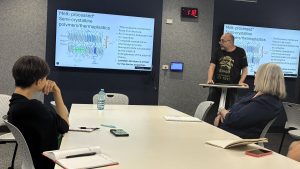
Dr Christopher Garvey visited the Centre through the Visitor Support Award program, contributing expertise in X-ray scattering techniques and supporting researcher development.
Why this research matters
Improving the performance of biodegradable plastics is an important step toward expanding the range of applications in which they can be used.
While the solvent-assisted stretching method explored in this study is not yet intended as a commercial manufacturing process, the insights gained provide valuable guidance for the development of scalable processing technologies for PHBV and related bioplastics.
By demonstrating a pathway to dramatically improve toughness without chemical modification, this work helps address one of the key barriers to broader adoption of biodegradable materials.
The publication also marks the first paper arising from Alia Gallet–Pandellé’s PhD research, highlighting the important contributions of emerging researchers within the Centre.
Read more
📄 Gallet–Pandellé, A., Chaléat, C., Colwell, J., Garvey, C. J., Pratt, S., Lant, P., & Laycock, B. (2026). A novel stretching method for enhancing the toughness of PHBV films. Polymer, 130545. https://doi.org/10.1016/j.polymer.2026.130545

