
Biodegradable plastics are often promoted as alternatives to conventional plastics, but their behaviour in natural environments is more complex than many people realise.
A new study published in ACS ES&T Water by Centre researcher Dr Tracey Read and colleagues examines how two widely used biodegradable polymers, poly(lactic acid) (PLA) and poly(butylene adipate-co-terephthalate) (PBAT), degrade in estuarine and coastal environments.
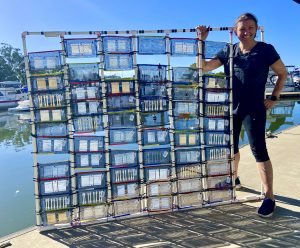
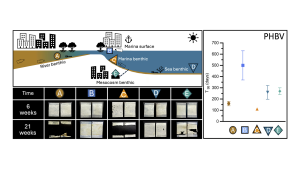
Images: Tracey Read in the field and visual abstract of article. The visual abstract compares the degradation of PLA and PBAT after 78 weeks of exposure in a range of estuarine and coastal environments. The images highlight how degradation behaviour can vary significantly depending on both the material and the surrounding environmental conditions.
PLA is a biobased compostable polymer, while PBAT is a fossil-derived biodegradable polymer commonly used in compostable plastic products. Although both materials are often grouped together as “biodegradable plastics”, the study highlights that their environmental performance depends on both the material itself and the environment in which degradation occurs.
Drawing on evidence from across the scientific literature, the researchers explored how factors such as temperature, UV exposure, oxygen availability, salinity, sediment characteristics and microbial activity influence degradation processes in rivers, estuaries and marine environments.
The findings demonstrate that degradation is highly context dependent. Materials that perform well under one set of conditions may behave very differently under another, helping explain why some biodegradable plastics degrade relatively quickly while others persist for much longer
Why this research matters
Biodegradable does not mean a material will degrade rapidly under all environmental conditions.
Understanding these differences is important for researchers, manufacturers and policymakers seeking to reduce plastic pollution and improve the environmental performance of plastic products.
The findings reinforce an important principle for sustainable materials design: there is no one-size-fits-all solution. Achieving meaningful environmental benefits requires selecting appropriate materials for specific applications and understanding how those materials behave across a range of real-world environments.
Publication
📄 Read, T., Chan, C. M., Chaléat, C. M., Laycock, B., Lant, P., & Pratt, S. (2026). Complex degradation of PBAT and PLA in estuarine and coastal waters. ACS ES&T Water. https://doi.org/10.1021/acsestwater.6c00672
Supporting the next generation of researchers
This publication also highlights the Centre’s role in developing future research leaders.
Lead author Dr Tracey Read completed her PhD through the ARC Training Centre for Bioplastics and Biocomposites and now continues her research as a postdoctoral researcher within the Centre. Her work focuses on understanding how biodegradable materials perform in real-world environments, helping inform the responsible design, use and management of sustainable plastics.

